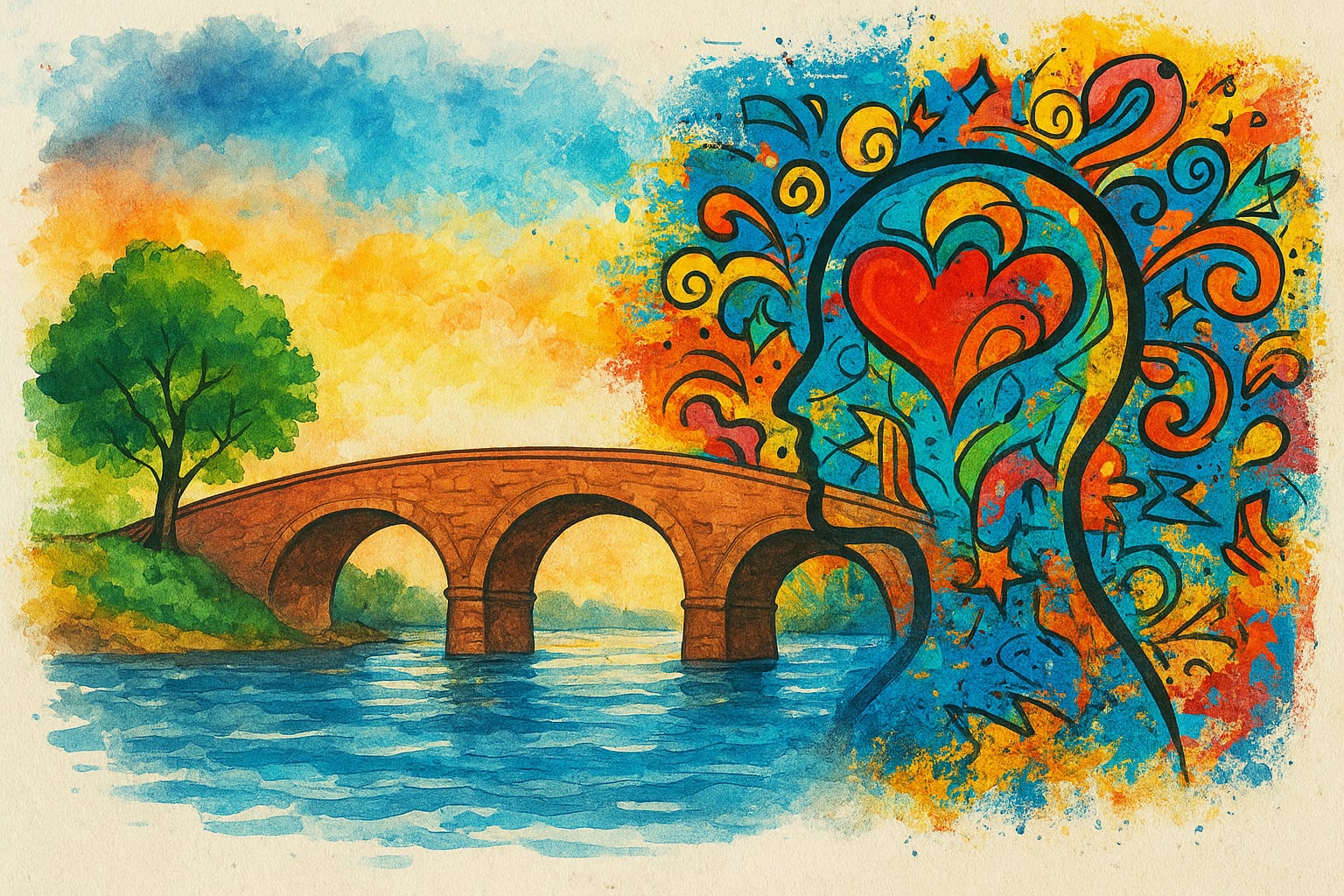
Bridging Imagination and Empathy: How Creativity May Help Us Understand One Another.
Bridging Imagination and Empathy: How Creativity May Help Us Understand One Another
By Marcia Banks
This article for LePôle grew out of a recent conversation with Sam Lohman of The Art Association (TAA), a Swiss nonprofit dedicated to fostering peaceful engagement through the arts. I am grateful for the opportunity to have explored these ideas with Sam and for his encouragement to expand my thinking about how creativity can empower students to understand one another more deeply. The section headings for this article draw from the prompts Sam Lohman shared during our interview.
You can learn more about TAA at theartassociation.ch, or see the full interview on the TAA YouTube Channel and Instagram: @theartassoc.
How might creativity connect us?
The sharing of a story, the performing of a theatre piece, or the collaboration on a project invites listeners, viewers, and fellow creators to see the world through someone else’s eyes. In those moments of engagement, differences may recede and what we share comes into focus - our laughter, our humor, our capacity for love, and our universal longing to be understood and valued. These forms of creativity may stir the imagination, and imagination is what allows empathy to grow.
In practical terms, this connection with another often emerges through small acts: a laugh shared over a playful idea or a team performing with the hope of evoking a specific emotion in their audience. A creative act becomes a bridge, linking one perspective to another and revealing something essential about our shared humanity.
What conditions allow for creativity to flourish?
Trust: Creativity is nourished and flourishes where there is trust, where people feel safe to take risks, make mistakes, and see failure as information rather than shame.
When cultivated in a collaborative environment, creativity becomes a bridge to empathy, allowing us to understand others’ perspectives, work together more meaningfully, and imagine new ways of being together. Trust is the foundation not only for creativity but also for effective teamwork and peaceful dialogue. Trust in oneself gives the courage to imagine and act—a quiet conviction that “I can make something better.” Trust in others allows ideas to be shared, reshaped, and built upon. In teams, trust transforms differences of opinion into opportunities for collaboration rather than competition.
The freedom to fail is also vital in creative collaboration. I’ve seen this repeatedly in Odyssey of the Mind (https://odysseyofthemind.com) teams, where students learn resilience through trial and error, gain confidence through persistence, and discover that the most unexpected ideas often lead to creative breakthroughs. As I wrote in a Le Pôle article, “Empowering Youth for a Positive Future,” https://lepole.education/en/post/success-stories/odyssey-of-the-mind-world-finals/) the Odyssey of the Mind program exemplifies how imagination, teamwork, and trust empower students to create, collaborate, and grow together.
Curiosity: My friend, Antonio Natale, an artist, believes that curiosity is the heartbeat of creativity. Curiosity fuels the search for truth, and Antonio expresses this through his art. In September 2024, Antonio spoke to me, for LePôle, on How an Artist’s Expression Might Inspire Others to Act with Kindness or Work Towards Peaceful Solutions. https://lepole.education/en/post/research/interview-antonio-natale/. He reflected on the power of art to inspire and evoke change, citing historical examples like Picasso’s Guernica, which condemned acts of war. He emphasized the importance of empathy in art, stating that modern artists must connect with their audience to convey their messages, effectively.
Creativity and its companion, a curious mindset, is, at its heart, a social process built on trust and emotional safety. When people are invited to think creatively, they learn the same skills that make peace possible: empathy, courage, and trust.
Creativity and today’s labor market
We are all born with imagination, and as children, creativity comes naturally. Yet, as Sir Ken Robinson famously argued in his 2006 TED Talk “Do Schools Kill Creativity?” and other writings, educational systems and societal pressures often suppress that innate creativity as we grow older. Nurturing and valuing creativity requires spaces where imagination is encouraged, supported, and allowed to thrive.
In my 2023 conversation with Dr. Jim Mourey for Le Pôle, How Do Constraints Positively Impact Creativity? (https://lepole.education/en/post/pedagogical-culture/how-do-constraints-positively-impact-creativity/) he described creativity as the driver of innovation, particularly in emerging technologies. Many of today’s recruiters are seeking individuals who have the skills of creative and innovative thinking along with creative problem-solving. In “Is Creativity A Soft Skill? (https://lepole.education/en/post/classroom-practices/is-creativity-a-skill/) the author, Tony Wan notes that creativity tops the lists of the soft skills most desired by employers.
How can art inspire peace?
Art, in all its forms, is a language of connection. Through stories, songs, and performances, artists help others see humanity in its many expressions. Art can awaken compassion, transform misunderstanding into curiosity, and turn a sense of separation into a shared experience. Of course, art can also divide and provoke; it can be used to harm as well as to heal. But when art is approached with empathy and integrity, it becomes a bridge that allows us to recognize ourselves in one another.
I’m reminded of the work of Pierre Dulaine, the internationally renowned ballroom dancer who founded Dancing Classrooms (https://www.dancingclassrooms.ch) to promote social and emotional growth through dance. Years ago, I had the wonderful opportunity to meet him in Geneva as he worked with various groups to promote ballroom dancing in clinics and in schools. I invite you to check out this website, Dance with Me, (https://www.dance-with-me.org/en/home) a Dancing community at the Clinic La Métairie, Nyon ( https://www.dance-with-me.org/en/our-projects/dancing-communities-en/dancing-communities-at-the-clinic-la-metairie). At that time I met Pierre Dulaine, he shared with me his enthusiasm for bringing his program to Israel and Jaffa, his birthplace, for a one-off experiment where he hoped to use ballroom dance to foster respect and connection between Jewish and Palestinian children. This experiment became the documentary, *<strong>Dancing in Jaffa*</strong>*,* (https://shineglobal.org/project/dancing-in-jaffa).
The program’s rule was simple: in the final competition, dance partners had to come from opposite communities. At first, the children giggled, avoided eye contact, or refused to touch hands. But with time something shifted. As Pierre said, *“When you hold someone’s hand, you can’t hate them.”*That dance floor became a microcosm of coexistence. Dancing together didn’t erase conflict, but it created a small win that mattered.
Art for peace is not about grand gestures or instant harmony. It’s about creating spaces where people can meet as equals, to dance, laugh, play, and create together.
What can we do to make creativity for peace more impactful?
One of creativity’s powers is its ability to reframe how we see problems. What if, instead of speaking of hate or cruelty, we called it forgotten empathy? What if every act of art-making became a reminder of our shared humanity? Could the arts help us practice empathy, rather than merely talk about it? Could small acts of creativity offer meaningful victories in divided communities? And what might happen if we collaborated on creating something beautiful before debating our differences?
Consider Denmark, where empathy-based learning (https://www.adeccogroup.com/future-of-work/latest-insights/empathy-in-denmark) is being integrated into early childhood education as a practical, lived skill. That shift required creativity: the courage to imagine something new, which now seems obvious in retrospect. Denmark is not alone; other schools are implementing programs such as Roots for Empathy (https://rootsofempathy.org) or The Natural Roots of Empathy (https://www.neufeldinstitute.org/our-courses/natural-roots-of-empathy#node_n_lpF5tTi2S0aDx5qX)
Creativity, the arts, and peaceful engagement share the same roots: imagination, curiosity, trust, and the courage to see the world a little differently. Creativity can be viewed as a positive social process where members are willing to ask for help, remain curious what others can offer, and let go of the belief that there must be competition for the “best” idea.
By nurturing the capacity to think creatively, individually and collectively, we protect our shared humanity and open the way for more compassionate, innovative, and peaceful ways of being together.