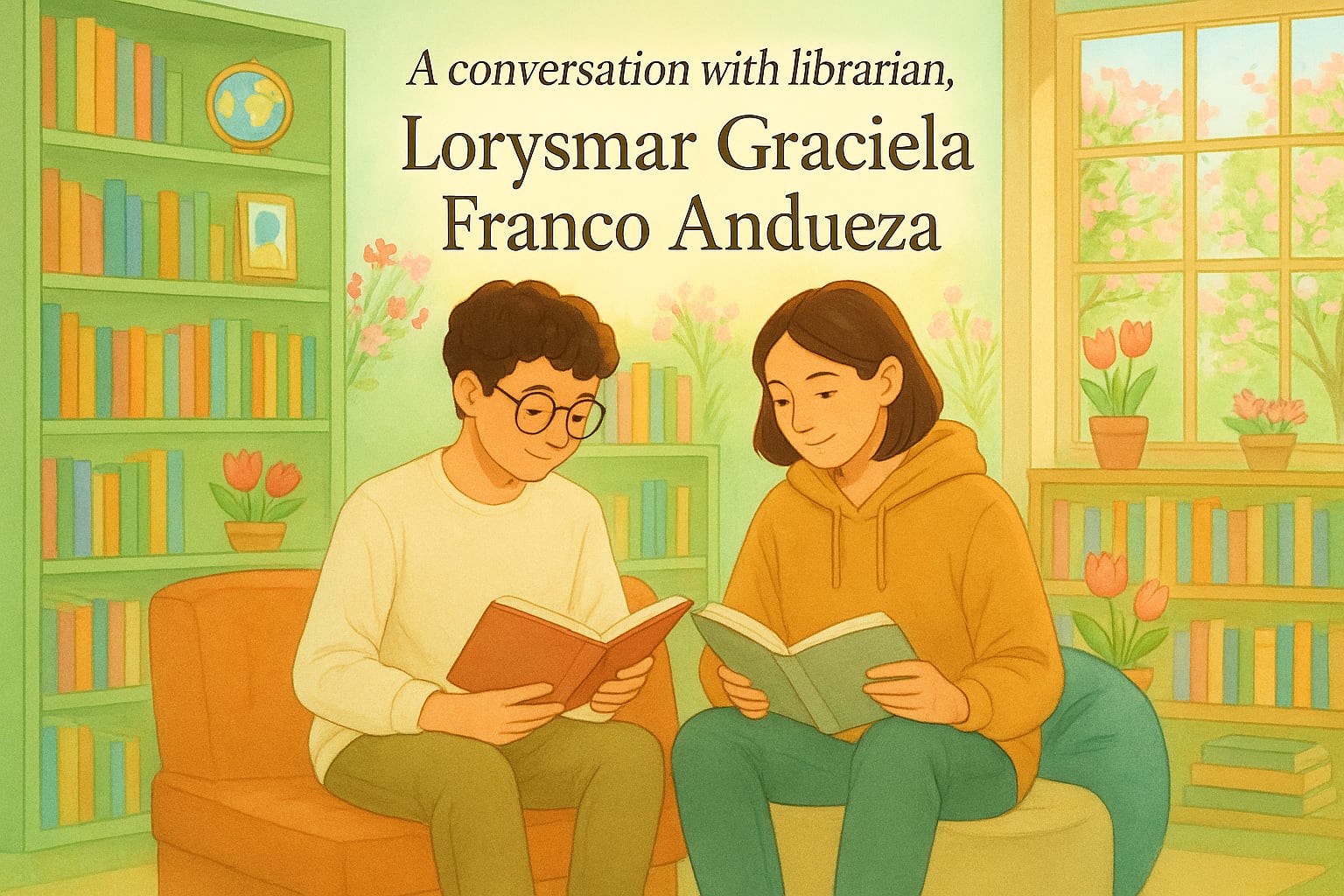
How a library can become not only a resource, but a relationship
By Marcia Banks
When most people think of a library, they imagine quiet stacks, rows of books, and a whisper of calm. But behind the shelves lies something more dynamic: curation, connection, and care.
A library isn’t just a place where books live—it’s where identities are affirmed, worldviews are expanded, and belonging takes root. At La Grande Boissière Middle School, Lorysmar Franco brings a global, multilingual, and human vision to her work as librarian.
I sat down with Lorsymar to learn more about what happens beyond the checkout desk: how a library becomes not only a resource, but a relationship.
Marcia: Tell me a little about your background, Lorysmar.
Lorysmar: I started working at the school last year, but I’ve been in academia for a while, mostly at the university context working with archives and patrimonial conservation. I hold a master’s in Hispanic and Latin American literature, and although my past library work was in a different context, it gave me a strong foundation.
Sometimes I have the opportunity to collaborate on library activities with the students, but most of my work happens behind-the-scenes: cataloguing, researching titles, and ensuring the library remains vibrant and relevant. A library isn’t just a warehouse for books—it should be alive, always evolving. That means regularly assessing the collection: What do we have? What’s missing? What’s outdated?
One of my guiding principles is global citizenship—using it to develop and curate a meaningful, inclusive collection.
Marcia: Please explain what you mean by building a library collection using the principle of global citizenship?
Lorysmar: It means approaching diversity and equity with depth. Instead of ticking boxes, we aim to include voices that are often underrepresented, particularly from the Global South. Publishing tends to be dominated by Western voices, which doesn’t reflect the diversity of our students or faculty. We’re a multilingual, multicultural school, but unless the library reflects that, we’re not truly supporting it. I consider the social, cultural and ecological dimensions of global citizenship and how they intertwine. The collection should reflect that complexity.
Marcia: How do you ensure students actually access and engage with these resources?
Lorysmar: First, we make sure the materials are available. Then we focus on two main strategies.
The first is expanding the collection with authors from the Global South. For instance, most of our French books come from France, but French is not only spoken in France or Europe but all around the globe. We need to reflect that. Including these voices isn’t just about geography—it’s about worldview.
Take Mafalda, a comic by the Argentine artist Quino. It’s smart, socially aware, and accessible to children. It aligns with our school’s values and shows how literature from the Global South can speak directly to students' lives.
The second strategy is promoting books in students’ home languages. Though the collection is small, it’s incredibly meaningful. If we value multicultural education, we need to support students’ linguistic identities. Seeing a book in your home language can be like finding a piece of home in the classroom. It’s powerful.
Marcia: That’s especially important for students transitioning into a new school, (source: https://lepole.education/en/post/training/why-is-a-child-s-transition/**) sometimes without knowing English or French. How do you use home-language books to help them integrate?
Lorysmar: I remember a Year 7 class with two new students who didn’t speak much English or French. The teacher and I selected books on environmental and social issues in their native languages—Italian and Russian—so they could still engage in class discussions and feel included. It also helped them develop the habit of reading, which then supported their transition into reading in the school’s primary languages. When navigating different genres in a new language, that early confidence makes a huge difference.
Marcia: Are the books from the Global South available in both translation and their original languages?
Lorysmar: That’s the goal. We have some translations in French, but ideally we would like to offer both original texts and translations. That way, students can access the material in a way that resonates with them linguistically and culturally.
Marcia: And what about the content of these books? Do they reflect a full spectrum of experiences?
Lorysmar: That’s another challenge. Often, the books we have from the Global South focus on migration, poverty, or trauma. Those are important themes, but they don’t represent the whole story. We also need books about philosophy, science, ecology, etc—works that reflect the intellectual richness of those cultures.
Marcia: Do we have examples in our current collection?
Lorysmar: Yes. One book features Xiuhtezcatl Martinez, a young Mexican-American ecological activits. His books touch on environmental ethics in a way that’s highly relevant to our students.
Marcia: Speaking of engagement, how do you help students transition from digital to print reading https://lepole.education/en/post/pedagogical-culture/how- comprehension-and-retention-are-affected-by-the-digital/? (source: https://lepole.education/en/post/pedagogical-culture/how-comprehension-and- retention-are-affected-by-the-digital/)
Lorysmar: Graphic novels and comics help a lot—especially for students used to reading in short bursts online. They make reading feel accessible. We have series like Wings of Fire in both English and French. They serve as a bridge between picture books and longer fiction.
Marcia: And if a student only reads comics?
Lorysmar: I try to guide them toward similar themes in different formats—maybe a short novel or illustrated nonfiction. It’s about meeting them where they are and gradually broadening their experience.
Marcia: That reminds me that when I was 9 or 10, I read classic comics in English (I was in a francophone community) about Greek myths and loved reading in English this way. Do you have materials like that?
Lorysmar: We do! We have a solid selection on mythology—especially in French. Subjects like philosophy or mythology can feel intimidating, but when they’re presented in an approachable format, students get engaged and often grow into more advanced material.
Marcia: And how do you encourage students to bring their own languages into the library?
Lorysmar: We have an initiative called Bring a Home Language Book. Over the summer, we ask students to bring back a book in their home language. It helps build our multilingual collection and creates a sense of ownership. They’re proud to see their contribution on the shelves. It’s not just symbolic—these are books they already connect with at home. And it deepens their connection to learning and identity.
Marcia: That’s such a beautiful way to build belonging.
Lorysmar: Absolutely. We already accept donations from parents, but this focuses specifically on languages that are harder to source. And those memories last. A student may one day say, “That was my book.”
Marcia: Earlier, you mentioned Édouard Glissant and his concept of Tout-Monde. How does that philosophy inform your approach?
Lorysmar: Glissant’s idea is that the world isn’t a homogenized whole—it’s a mosaic of interrelated cultures. He emphasized the concept of All-World (or Tout-Monde): the
idea that our identities are shaped through the interpenetration of cultures and imaginaries. Global citizenship isn’t about sameness—it’s about meaningful connection through difference. Difference and relationship thus appear as key plunderers in the mosaic that defines today’s society. That’s the lens I use when curating our collection. When students see a true mosaic of voices, they learn that their perspectives matter too.
Marcia: It’s such a powerful idea—valuing difference as a strength, not as a problem. Lorysmar: And not just difference between nations, but within cultures too. Everyone
brings something unique.
Marcia: Let’s return to how students find and use books in the library. How do you help them engage with the collection?
Lorysmar: We run library classes that teach students the Dewey system (the library classification system used by us) and how to navigate the space: therefore, they know how to find fiction, nonfiction, philosophy, documentary materials, etc. We use games like library bingo to make it fun and interactive. It gives them the confidence to explore independently.
Marcia: Do you host author visits?
Lorysmar: We’d love to do more of that. It’s not always easy to organize, but meeting the person behind the book creates such a strong connection. It reminds students that books aren’t just products; they’re personal, human, creative efforts. And maybe one day, they’ll see themselves as writers too.
Marcia: Do you highlight student writing?
Lorysmar: Some classes do poetry or creative writing that we display, but I’d love to feature more student work more intentionally in the future. That kind of visibility gives students confidence and pride. When students see themselves in the library, not just in the books they read, but in the books they write, it becomes a place of identity, connection, and growth.
Marcia: What do you think are the most important steps we can take to bring students into the library more often?
Lorysmar: I think the first thing is simply to have them here more regularly. We do have excellent resources, but getting students to really engage with them can be sometimes difficult. Some kids love the library and come often, but many only show up with their classes. For some of them, it’s not yet a place associated with passion for reading.
Marcia: Do you think the location of the library in the building plays a role in that?
Lorysmar: Definitely. But I actually think we’re lucky here. Our library is right in the heart of the school. It has a beautiful view, lots of natural light, and even an extra floor where students can read in a quieter space. We have everything we need: resources
for research, writing, and reading. The challenge is still how to help students connect to reading. Even as adults, we don’t always have the energy or focus to read, so it’s no surprise that it can be hard for children too.
Marcia: So how do you help individual students get past those barriers?
Lorysmar: A lot of it is about knowing them personally. Each student is different. Some might enjoy reading but feel intimidated by the format or unsure of what to read. Some read certain genres. That’s where a librarian really comes in, to guide them and help them explore new things. Creating a sense of comfort and curiosity is key.
Marcia: Speaking of comfort, do you have cozy spaces in the library for reading? As a classroom teacher, I once had a bathtub with a globe-themed shower curtain. Kids loved reading in the tub! Some even read under my desk.
Lorysmar: I love that idea! Yes, we’ve tried to create those little nooks where students can feel a bit hidden and safe. On both floors, we have corners with sofas and soft chairs, especially near the graphic novels. They gravitate toward those areas; they love being able to read together or find a quiet spot.
Marcia: That shows how space design can influence how a library is used.
Lorysmar: Absolutely. We’ve just added some new poufs downstairs to make the space more inviting. Most of the furniture we had was more suited to classroom use, as in tables and chairs for group work or research, yet not necessarily for relaxed reading. More comfort means more engagement.
Marcia Banks: If you had a magic wand, what would you wish for?
Lorysmar: More space! We have so many students and so many books, but not enough room to create a dedicated reading area where students could really spread out and not be disturbed. Somewhere they could read quietly, without being packed in. That said, we’re lucky to have this space. There’s light, greenery, and you can even hear the birds outside. Being connected to nature helps so much. It really changes the way you think and feel when you read.
Marcia: What about promoting new books and underrepresented voices?
Lorysmar: That’s a big part of our strategy. We use the school newsletter to showcase newly added titles; not just for students, but for parents too. Many parents want to know what’s new and often recommend books to their children. I’m also thinking about something called the “book spotlight” display to give visibility to great books that don’t get borrowed simply because they aren’t already popular. It’s a shame to let those gems gather dust.
Marcia: That ties in with highlighting peripheral or non-Western voices, doesn’t it?
Lorysmar: Exactly. Sometimes students don’t explore those books because they’ve never heard of them. It helps if someone puts the book in their hands and says, “You might like this because it talks about XYZ.” And we do a collection review every year,
usually at the end of the school year, to see what’s still relevant and what needs to be updated, not just in terms of condition but also content.
Marcia: Have you seen any concrete results from your efforts to promote home language collections?
Lorysmar: Yes! It’s a lovely anecdote, actually. We used to keep the home languages collection downstairs, but it was often overlooked. Last year, we moved it upstairs, right behind the desk, and since then, it’s been borrowed much more often. Kids come during break, browse it out of curiosity, or even borrow books to take home. That small change, just moving the books, had a big impact. It wasn’t just physical; it was conceptual. We brought these books “from the underground to the surface,” and that has helped reawaken students’ interest in their cultural heritage and language.
Marcia: That’s such a powerful image: “from the underground to the surface.” It really shows how something as simple as location can shape how students interact with books and with culture.
Lorysmar: Yes, and we hope to extend that same thinking to other parts of the collection, especially with new titles that promote inclusivity and diverse voices. Because ultimately, the library isn’t just about access; it’s about recognition. When a student sees their language, their heritage, or even their curiosity reflected in a book, something shifts. The library becomes a space not just to learn, but to belong.
That’s the goal. That’s what makes it alive.
Marcia: Thank you, Lorysmar, for sharing how a library is far more than a building filled with books; it is a living, breathing relationship between people, ideas, and possibilities. It is a place to belong.